
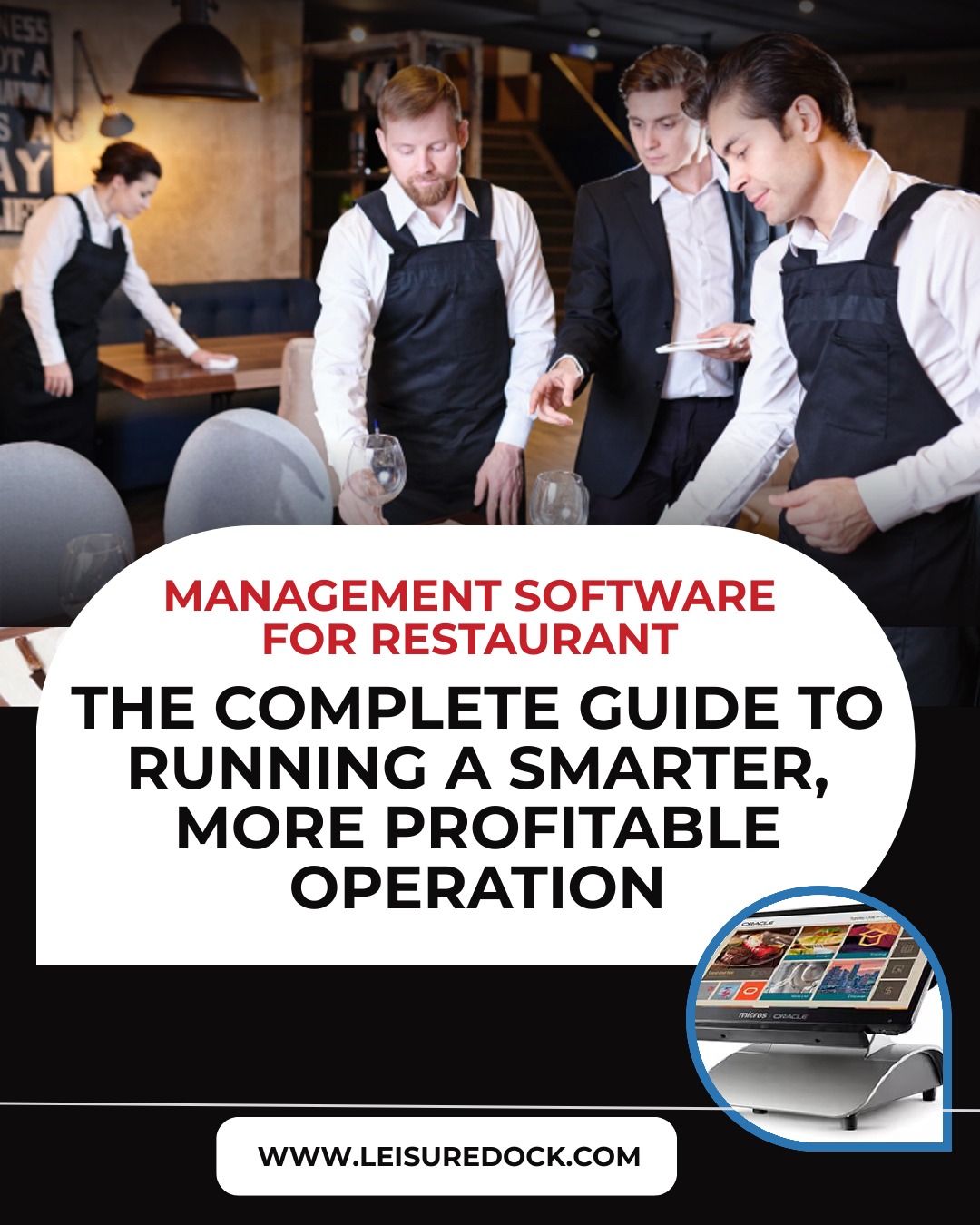
Ask any restaurant operator what their biggest daily challenge is, and the answer almost never starts with food. It starts with coordination, juggling reservations, managing tables, keeping track of guests, chasing no-shows, and somehow extracting meaningful data from a chaotic operational environment. The gap between a restaurant that feels perpetually reactive and one that runs with calm, consistent efficiency usually comes down to one thing: the management software for restaurant operations that sits at the centre of the business. Get that right, and almost everything else becomes more manageable.
This guide is written for restaurant owners, hospitality managers, and operators who are ready to move beyond manual systems and disconnected tools and find a platform that genuinely works in the real world. We will also walk through why LeisureDock is becoming the management system of choice for independent operators looking to compete more effectively without enterprise-level overheads.
Why Restaurant Management Without Dedicated Software Keeps Failing
The hospitality industry operates on razor-thin margins. A 3–5% net profit is considered healthy for most independent restaurants, which means operational inefficiencies that might be a minor annoyance in other industries are genuinely business-critical in food service.
Yet, in practice, the vast majority of independent restaurants are still managing core operations with a patchwork of tools that were never designed to work together: a phone for reservations, a whiteboard for table assignments, a generic calendar for booking notes, and a mental map of guest preferences that lives exclusively in the head of the most experienced staff member.
What this creates is a system that is entirely dependent on individual memory and informal communication, fragile by design.
The Hidden Cost of Operational Fragmentation
When systems don’t talk to each other, the cost shows up in ways that are easy to dismiss in isolation but devastating when totalled:
- Double-bookings that result in guests being turned away or offered unsatisfactory alternatives
- No-shows that go unaddressed because there is no automated reminder system in place
- Guest preferences that get lost when a team member leaves or is absent
- Revenue reporting that requires manual effort and is therefore rarely done with meaningful regularity
- Missed re-engagement opportunities with guests who visited once and never heard from the restaurant again
Individually, each of these feels like a minor inconvenience. Collectively, they represent thousands of pounds or dollars in lost revenue and goodwill every year.
The Scaling Problem
What makes this particularly acute is that it scales badly. A single-site operator managing thirty covers on a quiet Tuesday can paper over the cracks with manual systems. The same operator opening a second location, increasing covers, or pushing into event dining quickly discovers that the informal approach breaks down under volume. The management software for restaurant operations that was deprioritised in early-stage growth suddenly becomes the most urgent problem to solve.
The Landscape of Management Software for Restaurant Operations

The market for restaurant management technology has expanded significantly over the past decade. Operators now have access to a broad spectrum of tools, ranging from narrow, function-specific apps to comprehensive, integrated platforms. Understanding the difference matters, because the wrong choice creates a new category of problem: software complexity.
Category 1: Single-Function Tools
Apps that handle one function, reservations only, or waitlist management only, or stock tracking only. These are easy to adopt but create data silos. Your reservation system doesn’t know what your CRM knows. Your CRM doesn’t know what your floor management tool knows. The operator becomes the integration layer, manually moving information between systems.
Category 2: POS-Centric Platforms
Point-of-sale systems have expanded their feature sets over the years, and many now include basic table management and reporting. However, their architecture is built around the transaction, not the guest. They are strong at capturing what happened at the point of payment; they are typically weaker at managing the experience before and after that moment.
Category 3: Full-Stack Restaurant Management Platforms
This category represents the most complete approach, integrating reservations, floor management, guest CRM, automated communications, and analytics into a single platform. When it works well, a full-stack platform eliminates the need for multiple disconnected tools and gives operators a single, reliable view of their business. This is where the highest operational return is typically found, and it is the category that LeisureDock occupies.
LeisureDock: Management Software for Restaurants Built for Independent Operators
LeisureDock’s platform was developed specifically for the needs of independent and multi-site restaurant operators, not enterprise chains with dedicated technology teams and six-figure software budgets. The free restaurant management software gives operators professional-grade functionality that was, until recently, only accessible to larger groups.
Intelligent Reservation and Table Management

At the operational core of LeisureDock is its restaurant reservation and management system, a real-time platform that gives front-of-house teams complete visibility into bookings, table status, and upcoming covers. In practice, this means seating decisions are faster, conflicts are eliminated before they reach the guest, and the floor runs with far less internal communication overhead.
The system handles the full reservation lifecycle: accepting bookings, confirming via automated communications, sending pre-visit reminders, and capturing post-visit data. Operators do not need to manually follow up on any of these touchpoints, the platform handles them in the background while the team focuses on in-service delivery.
Guest CRM: Turning One-Time Visitors into Regulars
Every booking that passes through LeisureDock builds a guest profile automatically. Visit history, dining preferences, special occasions, and communication preferences are captured and stored, creating a CRM that grows in value with every cover served.
What we’ve seen in real use cases is that operators who actively use guest profiling data for their outreach campaigns achieve meaningfully higher repeat visit rates than those relying on generic marketing. The difference between ‘Dear Valued Guest’ and a message that acknowledges a guest’s last visit and references their known preferences is not subtle, it is the difference between an email that gets deleted and one that drives a booking.
Automated Communications That Protect Revenue
No-shows are one of the most consistent sources of revenue loss for restaurants that don’t actively manage them. LeisureDock addresses this with automated reminder workflows, confirmation emails sent at booking, reminder messages sent 24 to 48 hours before the reservation, and follow-up communications after the visit.
Based on real-world data, restaurants using automated reminders consistently see no-show rates drop by 30 to 50 percent. For a restaurant serving 200 covers per week, even a conservative reduction in no-shows represents a significant improvement in weekly revenue, without any additional marketing spend.
Analytics and Occupancy Reporting
Most independent restaurants operate without reliable data about their own performance. LeisureDock changes this by surfacing occupancy trends, booking source analysis, peak period mapping, and cover value metrics automatically. Operators can see which days are underperforming, which booking channels are driving the most revenue, and where the biggest opportunities for improvement lie, without manually compiling a spreadsheet.
A Free Entry Point That Removes the Risk
One of the most significant structural advantages LeisureDock offers is its free plan. Unlike competitors who require subscription commitments before an operator has validated the platform’s value for their specific operation, LeisureDock allows restaurants to access core management functionality at no cost and scale up as their needs evolve.
How LeisureDock Compares to Other Management Software for Restaurants

The Commission Model: A Hidden Cost That Grows With You
Several of the most widely-recognised restaurant booking platforms operate on a per-cover commission model. This pricing structure appears straightforward on the surface, you only pay when you get bookings. In practice, it means your technology costs scale directly with your revenue, in a way that does not reflect the actual value the software delivers at higher volumes.
An operator serving 500 covers per week pays five times as much as one serving 100, for the same software functionality. LeisureDock’s model does not work this way. The cost structure is predictable and does not penalise success.
Guest Data: Yours or Theirs?
This is a distinction that many operators overlook when evaluating platforms. On some major booking platforms, the guest relationship is owned by the platform, not the restaurant. Direct communication with your own diners can be restricted, and the data generated by your business is used across the platform’s entire network.
LeisureDock takes the opposite position: your guest data belongs to your business. You have full access to guest profiles, communication history, and CRM data, and you can use it to build direct relationships with your guests without platform-imposed restrictions.
Setup Complexity: Days vs. Hours
Enterprise restaurant platforms often require lengthy onboarding processes, third-party implementation support, and technical configuration that is simply impractical for an independent operator. LeisureDock is built for self-serve adoption, most operators are live with core functionality within a few hours, with no technical expertise required.
Practical Scenarios: Who Gets the Most Value from Management Software for Restaurants
The Owner-Operator Running Everything
An owner who is also their own reservations manager, marketing department, and data analyst needs systems that work without constant supervision. LeisureDock’s automation handles the repetitive touchpoints, confirmations, reminders, follow-ups, so the owner can be present in the restaurant without worrying about what is falling through the cracks.
The Expanding Group
A restaurant group opening its second or third location faces an immediate coordination problem: how do you maintain operational standards and guest experience consistency across venues without being everywhere at once? Centralised management software for restaurant groups provides consolidated reporting, cross-site data, and consistent guest communication frameworks, making the step-change from one site to multiple sites far less operationally traumatic.
The Event-Focused Restaurant
Restaurants that host private dining, tasting menus, or ticketed events face a distinct management challenge: the reservation is more complex, the guest communication is more involved, and the financial stakes of a no-show are higher. LeisureDock’s reservation management and automated communication tools handle the logistical complexity of event bookings in a way that generic calendar or booking tools simply cannot.
The Restaurant Prioritising Guest Retention
The economics of guest retention are straightforward: acquiring a new restaurant guest costs significantly more than retaining an existing one. Operators who use LeisureDock’s CRM tools to identify lapsed guests, acknowledge loyal visitors, and personalise their outreach consistently see higher lifetime value per guest, without increasing their marketing budget.
Expert Tips for Implementing Management Software for Your Restaurant

Tip 1: Audit Your Current Process Before You Switch
Before adopting any new platform, map out exactly how reservations, communications, and guest data currently move through your operation. Understanding where information gets lost or delayed in your existing system tells you precisely which features to prioritise in your new software, and helps you set realistic expectations for what will change.
Tip 2: Treat the First 30 Days as a Learning Period
The first month of using any new management software is about calibration, not perfection. Your team will develop habits, your data will start to accumulate, and you will identify configuration adjustments that make the platform work better for your specific service style. Give the system time to demonstrate its value before drawing conclusions.
Tip 3: Use Occupancy Data to Rethink Your Quiet Periods
One of the most actionable uses of the analytics that management software provides is identifying underperforming time slots. Rather than accepting low Monday evening covers as inevitable, use booking data to inform targeted promotions or set menu offerings timed specifically to those periods. The data is there, operators who use it proactively consistently see better distribution of covers across the week.
Tip 4: Build Guest Communication Into Your Operational Rhythm
Automated reminders are table stakes. The operators who get the most from their CRM are those who go one step further, using guest history to time personalised offers, acknowledge loyalty, and re-engage lapsed visitors. Set aside time monthly to review your guest data and activate at least one targeted communication. The return on this effort is consistently positive.
Tip 5: Train Your Whole Team, Not Just the Manager
Management software for restaurants delivers its full value when every team member understands how to use it correctly. A host who defaults to a paper backup because they don’t trust the system creates gaps in your data and undermines the consistency the platform is meant to provide. Invest in proper team training at the outset, it pays back quickly.
Frequently Asked Questions: Management Software for Restaurant Operations
Q: What is management software for a restaurant?
Ans: Management software for a restaurant is a digital platform that centralises and automates the key operational functions of a food and beverage business, including reservations, table management, guest communications, CRM, and performance reporting. Rather than managing each function with separate manual processes or disconnected tools, a restaurant management platform provides a single system that connects all operational data in one place.
Q: Do small restaurants need management software?
Ans: Yes, in fact, small restaurants often benefit most from management software because operational inefficiencies have a proportionally larger impact on a lean team and tight margins. Even a modest reduction in no-shows or an improvement in table utilisation can represent a material change in weekly revenue. When management software is available on a free or low-cost plan, the barrier to adoption is minimal and the upside is significant.
Q: What is the best management software for a restaurant on a tight budget?
Ans: LeisureDock offers one of the most accessible management software options for restaurants on a budget, with a free plan that includes core reservation and table management functionality. This allows operators to access professional-grade tools without committing to monthly subscription fees before they have validated the platform’s value for their specific operation.
Q: How does management software for restaurants reduce no-shows?
Ans: Restaurant management software reduces no-shows by automating reservation reminders, typically sent via email or SMS 24 to 48 hours before the booking. Data from restaurants using automated reminders consistently shows no-show rate reductions of 30 to 50 percent. For any restaurant serving significant weekly covers, this represents a direct and measurable improvement in revenue without additional marketing spend.
Q: Can restaurant management software help with guest retention?
Ans: Yes. Management software for restaurants that includes a guest CRM captures visit history, preferences, and communication data, enabling operators to personalise outreach, acknowledge loyalty, and re-engage lapsed visitors. This data-driven approach to guest communication consistently outperforms generic marketing and produces higher repeat visit rates over time.
Q: What features are most important in restaurant management software?
Ans: The most important features in management software for a restaurant are: real-time reservation and table management, automated guest communications (confirmations, reminders, and follow-ups), a guest CRM that builds profiles from booking activity, operational analytics and reporting, and an interface that your entire front-of-house team can use without technical training. Integration capability with your existing POS system is also worth evaluating.
Q: How long does it take to implement restaurant management software?
Ans: Implementation time varies by platform. A straightforward independent restaurant can typically go live with core LeisureDock functionality within a few hours, as the platform is designed for self-serve onboarding without technical expertise. More complex configurations, multi-site setup, staff permissions, custom communication templates, may take a day or two.
Q: Is cloud-based management software better for restaurants?
Ans: Cloud-based management software for restaurants is generally superior to on-premise alternatives for most independent and growing operators. Cloud platforms do not require dedicated hardware, update automatically, are accessible from any device, and scale without infrastructure investment. For operators managing multiple locations or needing remote access to their data, cloud-based software is the clear practical choice.
Q: What is the difference between restaurant management software and a POS system?
Ans: A POS (point of sale) system is primarily built around processing transactions, it captures orders and payments. Restaurant management software focuses on the broader operational and guest experience lifecycle, reservations, table management, guest communications, CRM, and analytics. The two systems serve different functions and are most effective when used together, with data flowing between them.
Q: How does restaurant management software affect profitability?
Ans: Management software for restaurants affects profitability through several mechanisms: reducing no-shows (recovering revenue that would otherwise be lost), improving table utilisation through better floor management, enabling targeted guest re-engagement through CRM tools, and surfacing analytics that allow smarter decisions about staffing, pricing, and promotions. In practice, the combined impact of these improvements typically produces a meaningful uplift in revenue per cover within the first few months of adoption.
Q: Can management software for restaurants handle online bookings?
Ans: Yes. Modern restaurant management platforms like LeisureDock include online booking functionality as a core feature, allowing guests to make reservations directly through the restaurant’s website or a bookable listing, with all data feeding automatically into the central management system. This eliminates manual entry, reduces booking errors, and provides a seamless experience for both the guest and the operator.
Conclusion: The Right Management Software for Your Restaurant Is a Competitive Advantage
The gap between restaurants that grow and those that stagnate is rarely about the quality of the food. More often, it comes down to operational infrastructure and whether the systems supporting the business are built for scale or improvised for survival.
Management software for restaurants is not a luxury reserved for large chains. It is a practical operational decision that independent restaurants of all sizes are now making, and the ones making it earlier are consistently building stronger businesses.
What we’ve seen, across real operators who have made the transition from manual systems to integrated management platforms, is a consistent pattern: fewer operational fires, more reliable guest communications, better data for decision-making, and a team that spends less time on administrative coordination and more time on service delivery.
LeisureDock offers one of the most accessible paths to this outcome, with a free plan that removes the financial risk of adoption and a platform purpose-built for independent operators. If you are ready to replace the patchwork of manual processes with a system that actually works, explore LeisureDock’s free restaurant management software and restaurant reservation and management system today.
0 Comments